When to replace a Melbourne deck and when to repair it
Soft spots, a dancing stair and a ledger that has stained the weatherboard — a field guide to knowing whether you are in for new boards or a new structure.
By Tom Nguyen, Building writer · 7 October 2025 · Updated 15 March 2026
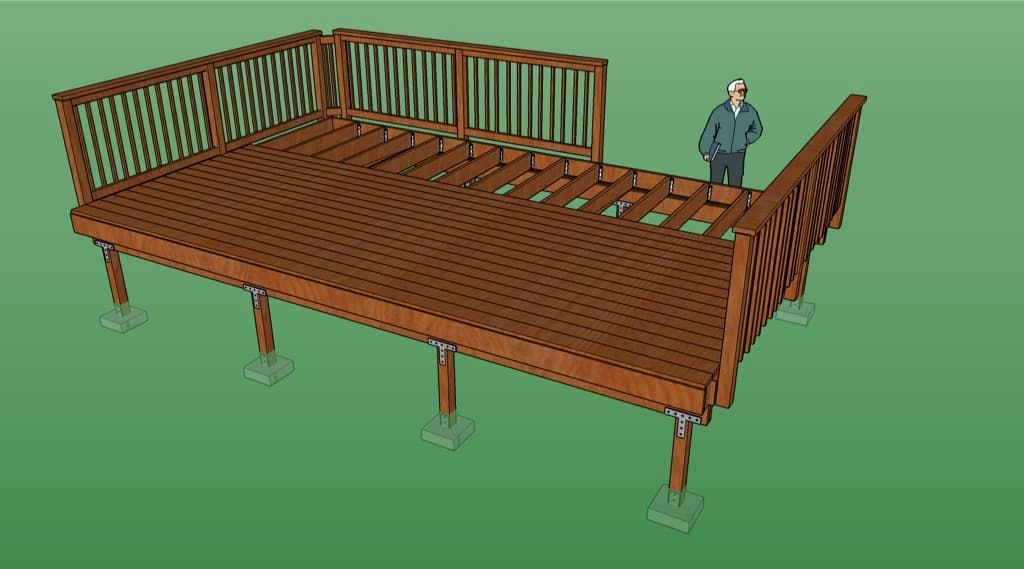
Photograph: CorporateM. Anatomy of a deck.jpg. CC BY-SA 4.0. Source on Wikimedia Commons. See all image credits.

Decks fail politely at first. A screw backs out. A board cups. A stair feels lively. Then someone puts a foot through a riser in July and the conversation changes tense. Melbourne’s contribution is moisture: a frame that never dries, a ledger that drinks, a south corner that has been a planter for years.
Repair is noble when the grid is sound. Replacement is cheaper than a series of heroic patches when the grid is compost.
The inspection you can do before you call anyone
From above: sprung boards, rust streaks, movement at posts, a stair that racking when you lean the rail. From the edge: look under if you can. White, fluffy fungal growth, joists that have lost their arris, bearers with the centre hollowed, and stumps that have concertinaed are all end-of-argument sights.
At the house: staining below the ledger, bubbling paint, a gap that opens and closes. The wall connection is a common place to find that the deck has been quietly dismantling the cladding. See substructure.
Push, do not jump. If you need a screwdriver to make a point in a joist, you have your answer.
Repair when the face is the problem
Boards worn, grey, splintered, but joists firm and dry: restore or replace the wearing surface. That might be a restoration, a new hardwood, or a composite on the existing centres if the spacing suits.
Refasten a nailed deck to stainless. Replace a broken stringer. Add a mid-span joist if the bounce is span, not rot. These are repairs.
A single soft board over a dry joist is a board. A line of soft boards over a dark, wet bearer is a bearer.
Replace when the structure is the problem
In-ground pine that was never H4. Posts sitting in a pond. A ledger bolted through a rotting bottom plate. Joists at 600 mm centres under a composite that wants 400 mm and already cracking. Termite galleries. A waterproof “deck” over a room that has stained the plaster — that is a membrane replacement, not a sand.
If more than a third of the frame needs surgery, price a new deck. You will reuse footings only if they are in the right place, the right depth, and sound. Often they are not.
A raised deck with a suspect rail is a safety replacement even if the boards look fine. See NCC handrails.
Money, disruption and the honest programme
Repair can be done in stages. Replacement is a week or three without a back door, a skip on the nature strip, and a chance to fix the fall you never had. Read costs and hiring.
Do not let nostalgia for the old merbau keep a dangerous stair. Salvage good hardwood for a bench if you must. The new floor can still be timber.
A failed deck is information. It tells you where water sat. The next one should not sit there.
The sale, the report and the deck you cannot hide
A building inspector will find the soft stair. If you are selling, a known, priced repair is better than a fresh oil over a bounce. If you are buying, take a screwdriver and a sceptical afternoon light. Grey boards are normal. Soft joists are a negotiation.
Insurance rarely loves gradual rot. Do not assume a claim. Assume a builder.
Sequencing a replacement so the house still works
If the deck is the only back door, ask for temporary stairs. If the laundry exits onto it, plan a week of shoes off at a different door. Demolition will fill the garden with nails; a magnet roller is not cute, it is necessary.
Build the new fall, the new ledger flashing, the new rail. Do not replicate the failure in prettier timber.
Repair celebrates what is still working. Replacement admits what is not. Both are respectable if you name them correctly.
Salvage, skip and the nails that stay
Old hardwood boards can become a bench, a planter edge, or firewood if they are untreated and you are allowed to burn. Old treated pine is not firewood. It is a tip.
Spend an hour with a magnet after the skip leaves. The lawnmower will find what you miss.
Then build the next deck as if you had already met this one in year twelve. You have.
Talking to the household
A failed deck is a disruption. Tell the people who use the back door what the week looks like. Pack the barbecue. Move the pots. Decide whether the dog can be in the yard with an open undercroft.
The social plan is part of the building plan. A replacement goes better when nobody is trying to host a birthday on the second day of demolition.
Then let the new structure be drier and more lawful than the old one. That is the only good reason to go through it.
Get one independent look if the quote to repair and the quote to replace are close. A second carpenter with no interest in the demolition skip will tell you whether the frame has a season left. Pay for that hour. It is cheaper than the wrong kind of hope, and cheaper than a new hardwood face on a joist that has already decided to finish. If the stair is the failed part and the main plane is sound, replace the stair as a structure, not as a cosmetic. People fall on stairs. Boards can wait a season; a lively stair should not. Photograph the failed bits before demolition. You will want to remember where the water sat when you brief the next frame. Memory is optimistic; photographs are not. A failed deck is not an embarrassment. It is a weather report written in timber. Read it, then build the drier version.
Questions we are asked
- How long should a deck last in Melbourne?
- A well-built hardwood wearing surface can give you decades. A wet pine frame in the dark can fail in well under ten years. Life is about dryness and detailing, not a single number on a brochure.
- Is a bouncing deck always dangerous?
- Bounce can be undersized joists rather than rot. It is still a reason to investigate. If bounce comes with softness, rusted fasteners or movement at the house, stay off the high edges and get a builder or surveyor.
Canonical URL: https://deckingmelbourne.com.au/articles/replace-vs-repair-failed-deck