Designing a north-facing deck for Melbourne sun and shade
North is the prize in Victorian houses — until January, when the same deck becomes a skillet. How to aim a deck at winter sun without ruining summer afternoons.
By Eleanor Hart, Editor · 28 February 2025 · Updated 15 January 2026
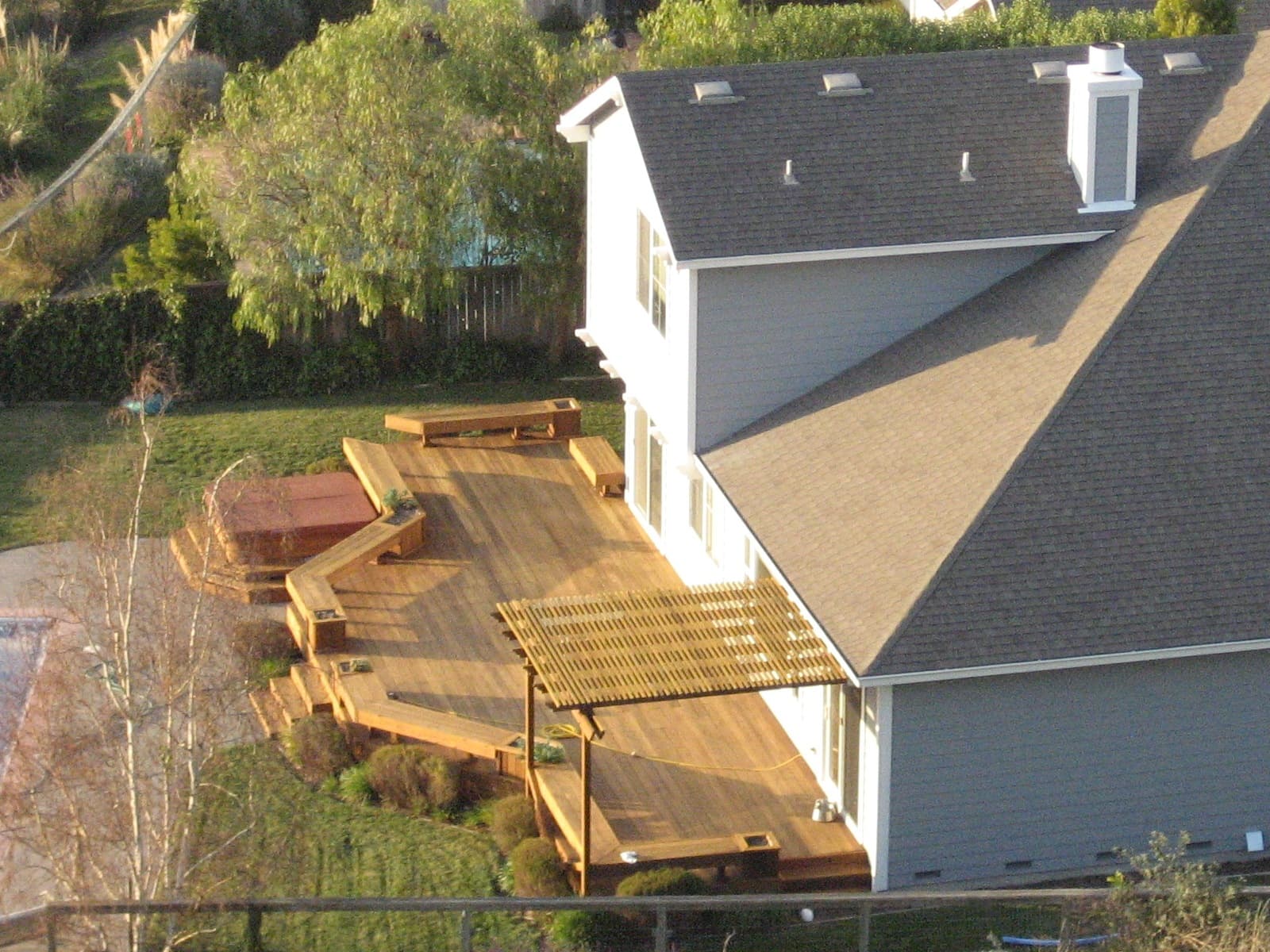
Photograph: en:User:JDoorjam. Backyard deck.JPG. CC BY 2.5. Source on Wikimedia Commons. See all image credits.

Melbourne houses are planned around the north the way some cities are planned around a view. We want winter sun on the floorboards, a place to eat outside in September, and a garden that does not live in permanent shadow. A north-facing deck is the usual answer. It is also, in a western-suburbs courtyard with dark composite and no tree, a reason people stay inside in January.
Good orientation is not a compass tattoo. It is a section through the year.
What north actually gives you
In Melbourne, true north puts low winter sun deep onto a deck and high summer sun more steeply overhead. That is why a correctly sized eave or pergola can shade December and still admit June. Magnetic north on a phone is close enough for a sketch and not close enough for a brise-soleil you will live with for twenty years. Look at a sun-path diagram for 38 degrees south, or stand on the site at 9 am, noon and 4 pm in the season you care about.
A north deck off a living room is the classic Victorian alteration: open the rear wall, step out, eat. It works in Brunswick weatherboard houses and in new estates in Clyde, with different neighbours and different overlays. The failure mode is a deck that is all exposure — no wall, no tree, no roof — so the same space that is perfect in April is abandoned from Boxing Day until the first cool change.
Shade that understands the calendar
Fixed shade should be designed for solar altitude, not for the sail that was on sale. A pergola with north–south slats, or a roof that stops short of the winter sun line, is more useful than a solid patio roof that turns the living room into a cave. If you want vines, choose deciduous ones and accept the annual mess; an evergreen on a north pergola is a winter tax.
Sails are flexible and ugly when they are an afterthought. They also become sails in a south-westerly. If you use cloth, engineer the fixings into the house and posts, not into a fascia that was never asked.
Trees are the best shade we have and the slowest. A deciduous tree to the north-west of the deck is a gift to the 4 pm summer sun. Planting it after the deck is built is still worth it; planting it in a pot on the deck is a watering project. See decking around established trees if the tree is already the client.
A covered deck is a different room. It extends the year. It also changes planning, structure and the amount of light in the house. Do not roof the whole north face because one January was hot.
Surfaces, glare and the colour of heat
Pale hardwood left to silver reflects more light into the house — lovely in June, harsh if you have a west-facing kitchen behind it. Dark composite soaks heat. Merbau in full north sun will move and will need a finish decision; see staining versus oiling.
Glare off a north deck into a television room is a real complaint. A deeper threshold, a change of level, or a planted edge can break the bounce. So can a screen that is not a prison.
Furniture will fade. Specify for UV or accept that the cheap chairs are seasonal.
Wind, rain and the myth of the perfect aspect
North does not mean dry. A north-westerly in summer is hot and dirty. A south-westerly will still wet a north deck if the house does not block it. Falls still matter. A north deck with a lip at the door and no fall away from the house will put winter rain under the skirting. Read drainage.
If the only available direction is south, do not fake a north story. Design for shelter, lighting and a winter sun patch somewhere else — a side court, a roof, a walk. East is breakfast. West is the hard one in Melbourne; if west is what you have, shade is not optional.
Orientation is the first line of the brief. The second is how you will be on that deck in the month you currently hate. Draw both.
Furniture, glare and the lived-in north
A north deck will bleach the cheap teak copy and fade the outdoor rug you loved in the shop. Buy for UV or accept rotation. A pale umbrella on a dark composite deck can drop the temperature enough to make January usable; it also needs a base that will not take off in a south-westerly.
Glare into a north living room can be managed with a deeper reveal, a planted trough, or a change of board colour at the threshold. You do not have to roof the sun to tame it.
When north is not available
Many terraces only open south or west. A south deck wants winter light from the side, good lighting, and a finish that can live with moss. A west deck wants shade from 2 pm and a surface that will not burn. Do not force a north story onto a west hole.
The best Melbourne decks are honest about their aspect. They take the winter sun they can get and they protect the summer hour people actually use. A compass is the start of that honesty, not the whole design.
Planting the north edge without stealing the winter
A deciduous tree to the north-west is a gift. An evergreen hedge on the north edge is a theft. If you need privacy on the north, use a high screen only on the slice that faces a window, and keep the rest of the sun.
Pots on a north deck cook. Choose large volumes or accept that you are watering at dawn. Pale pots cook less than black ones, which is the same lesson as boards.
A north deck is still the right default in this city. Just design the January afternoon as carefully as you design the June morning.
Questions we are asked
- Is a north-facing deck always best in Melbourne?
- It is the best starting point for winter living. It is not automatically comfortable in summer unless you add shade, a place to retreat, and a surface that will not burn feet. East and west decks have their own hours; south decks need a different brief.
- How much shade does a north deck need?
- Enough to cut the high summer sun and leave the low winter sun. A pergola with slats or a deciduous vine, sized to the sun angles at your latitude, does more than a random sail that also blocks July.
Canonical URL: https://deckingmelbourne.com.au/articles/north-facing-deck-melbourne