Covered decks and pergolas for Melbourne winters
A roof turns a deck into a room and a planning object. How to add shade and winter shelter without cooking the house or collecting a pond.
By James Calder, Landscape writer · 8 August 2025 · Updated 11 March 2026
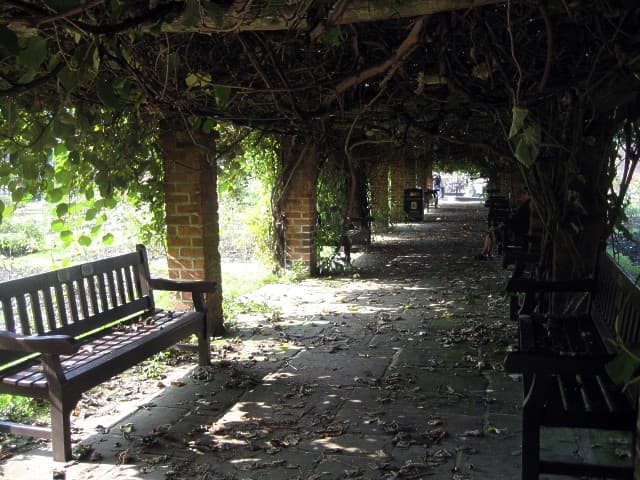
Photograph: Mike Kirby. Pergola, Thornes Park, Wakefield, West Yorkshire - geograph.org.uk - 969193.jpg. CC BY-SA 2.0. Source on Wikimedia Commons. See all image credits.

Melbourne’s outdoor year is longer if you can keep rain off the table and sun off the western edge. A pergola or a roofed deck is the usual move. It is also the move that turns a simple platform into a small building: extra load, extra water, extra paper.
Decide what you are buying. Summer shade. Winter sitting. A place to hang a light. Those are three different roofs.
Slat, sail, solid, glass
Slats, set to the sun path, are the intelligent north option. They cut high summer sun and admit low winter sun if you get the spacing and the depth right. See north-facing decks. They do not keep a July rain off the timber, so the deck still weathers.
A sail is fast and angry in a south-westerly. Engineer it or it will teach you about fixings.
A solid roof — metal, polycarbonate, tiles — makes a true outdoor room and a stormwater job. It will change the light in the house. It will also keep the deck drier, which is kinder to oil and to winter breakfasts. Gutters must go somewhere that is not the neighbour; see drainage.
Glass or insulated panels extend the season further and cost like architecture. They need ventilation so you do not build a greenhouse of sausage smoke.
Structure is not a kit from a trailer
A roof is wind load. Posts that were fine for a bare deck may not be fine for a lid. Attachments to the house have to find structure, not cladding. On a waterproof deck, the posts were supposed to be drawn yesterday.
If you are on a slope or in a BAL area, the roof is part of those stories. Ember mesh, non-combustible cladding, and not storing kindling under a pine lid all come back.
Permits are more likely once you add a roof. Budget the paper.
Living under it
Lights, a heater, an outdoor kitchen — each needs air and a clearance. An unflued heater under a low polycarbonate roof is a headache machine. A fan helps in still January courtyards.
Plants on a pergola are a climate system. Deciduous vines are the correct romance on the north. Evergreen on the north is a winter tax. Leaves in gutters are a July job.
The deck finish can change. A covered deck may hold a stain longer and grow mould where the rain never rinses. Wash anyway.
A cover is how Melbourne people keep using the money they spent on timber. Draw the sun, the water and the load, then pick a pretty beam.
Water off the lid
A roof is a rain collector. Gutters that dump onto the deck boards will stain, swell and grow a stripe of mould. Take the water to stormwater. On a tight site, a slimline tank under the deck can be part of the story if the overflow is legal and the tank is not a mosquito farm.
Polycarbonate roofs rattle and yellow if you buy the cheap sheet. They also make a drum in hail. Metal roofs need insulation if you do not want a summer oven. Glass needs a fall that does not pond at the house.
Where the roof meets the existing gutter, do not invent a flashing on the day. That junction leaks more often than the pretty beam.
Using the room you just made
A covered deck will host heaters, lights and the leftover refrigerator. Each of those wants a weather-rated point and a person who is allowed to install it. A daisy-chain of outdoor sockets under a bench is how Peninsula houses get interesting electrical stories.
Furniture will stay out. Specify for wet. Cushions still need a home in July.
If the cover is for a weekender, make the table zone the covered zone and let the rest of the deck weather. You do not need to roof the entire backyard to have a place to sit when the change comes through.
Melbourne rewards a roof that understands sun and water. It punishes a lid that was only a shade cloth with ambitions.
Neighbours, smoke and the enclosed feeling
A roof makes voices linger. A solid lid over a boundary barbecue will hold the smell against the fence. Put openings on two sides if you can. A pergola that is a tunnel is a drum.
If you later want blinds or drop-down screens, you are moving toward an outdoor room that planners may read as floor area. Check before you turn a pergola into a tent.
The best Melbourne covers are slightly incomplete: slats that still see weather, a solid strip over the table, an open edge to the garden. Perfect enclosure is a different building.
Smoke, heaters and the height of the lid
Measure the finished height to the underside before you fall in love with a low, Japanese-looking beam. A heater, a tall guest and a hanging light all need air. A lid that feels intimate in a showroom can feel like a bunker when twelve people stand up at once.
If you cook under it, give smoke a lee. A solid roof on all four sides with one opening is a smokehouse. Two open sides and a high point will save your eyes and your paintwork.
In summer a dark metal roof will radiate. Insulation or a paler colour is comfort, not luxury. In winter a polycarbonate lid will drum and leak at every cheap washer. Spend on the sheet and the flashing.
A cover is a climate machine. Specify the climate you want — shade, dry table, winter sitting — and stop adding layers until you have a different building.
If you add sides later — blinds, screens, a wall of glass — stop and ask the surveyor whether you have just created a habitable room. Many Melbourne pergolas become illegal extensions one season at a time. The first roof was the moment to get the paper right; the second wall is the moment to get it right again.
Questions we are asked
- Does a pergola need a permit in Melbourne?
- Often, once it is a roofed structure of a certain size, attached to a house, or in an overlay. An open slat pergola can still trigger rules. Ask a surveyor before you order steel.
- Will a solid roof make my house dark?
- A deep, solid lid on the north side can. Design for winter sun if the rooms behind need it, or keep the roof as slats, glass, or a shorter eave. See north-facing decks.
Canonical URL: https://deckingmelbourne.com.au/articles/covered-decks-and-pergolas